 Click here for the Japanese version of our homepage.

From oven heating to small reflow ovens
Rethinking heating reproducibility and productivity from the ground up with small reflow ovens.
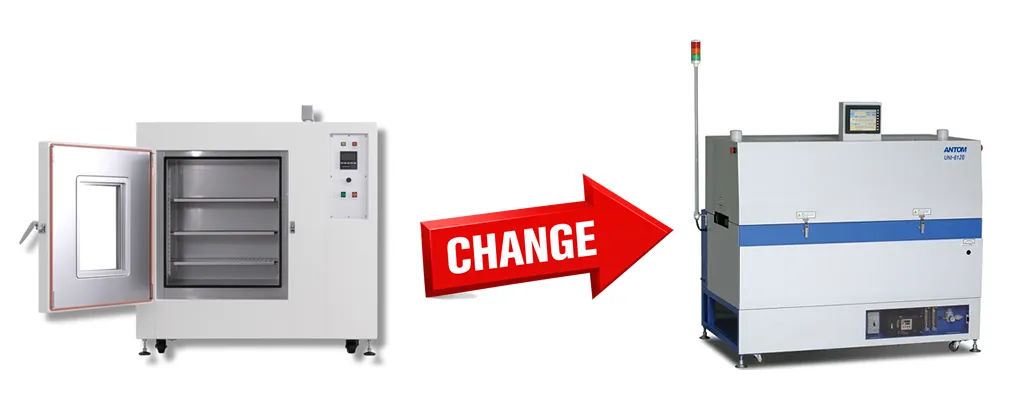
The oven heating process is often continued simply because:
“It works for now” or “We’ve always done it this way.”
However, with the increasing demand for production stability, quality reproducibility, and addressing labor shortages, the “invisible limitations” of oven heating are clearly beginning to hinder progress on the factory floor.
This page outlines, from a practical factory perspective, what changes and problems can be solved by switching from oven heating to a small reflow oven (convection type).
Common problems that occur with oven heating
While ovens have a simple structure, achieving consistent heating quality requires a great deal of “human ingenuity.”
• Heating differences between different locations within the device
• Variations in loading and unloading timing by operators
• Actual temperature history that varies from lot to lot
As a result,
“Even under the assumption of the same conditions, the results are not the same”
This situation tends to become commonplace.
The often overlooked issue of “reproducibility”
The biggest problem with oven heating is not the defects themselves, but the low reproducibility.
• It is difficult to isolate the cause when problems occur
• Quality assurance and customer explanations become difficult
This is true not only for mass production, but also for prototyping, reliability testing, and evaluation processes.
The option of a small reflow oven (transport type)
A small reflow oven is a device that controls heating zone by zone while transporting the workpiece at a constant speed.
The crucial difference from an oven is that heating is controlled by a “temperature profile” rather than “time.”
• Automatic transport without human judgment
• Conditions can be reproduced and shared numerically
This transforms the heating process itself into a controllable process.
Changes observed after switching to a small reflow oven
In facilities that have switched from ovens to small reflow ovens, the following changes have occurred:
• Shorter setup and start-up time
• Elimination of operator dependence
• A first step towards labor saving and automation
A major advantage is that the process can be streamlined simply by changing the equipment, without the need for special process improvements.
Processes where a small reflow oven is suitable
Small reflow ovens are easy to install even in locations with limited space and are suitable for applications where you want to automate just one process to start with.
Small reflow ovens are particularly suitable for the following processes:
• Prototyping, evaluation, and reliability testing
• Small-batch, high-mix production and semi-mass production
• Processes where you want to minimize human intervention
Why choose Antom’s compact reflow ovens?
Antom’s compact reflow oven employs a unique heating method that combines moderately hot air with far-infrared radiation.
• Avoid rapidly heating only the surface
• Deliver heat gently to the interior
Therefore, it can solve problems that occurred with conventional ovens without replacing them with other issues.
The idea of ”switching” to a small reflow oven.
There’s no need to completely reject oven heating.
However,
• Manageability
• Future Automation
Considering these factors, it’s true that small, transport-type reflow ovens are becoming the next standard.
Switching from an oven to a small reflow oven is not about upgrading equipment, but about changing the way you think about the process.
If you’re struggling with heating, start by re-examining your equipment and defining “what constitutes optimal heating.”
For those considering switching from an oven
We propose the optimal compact reflow oven tailored to your application and workpiece conditions.
Please feel free to contact us for consultations regarding the introduction of a compact reflow oven, as well as for demonstrations using actual equipment and profile measurements.
Product inquiry form
We will contact you within two business days (weekdays) regarding your inquiry submitted through the form below. Please wait a moment.
If you do not receive a response from our representative after two business days, there may be an issue with email delivery. In that case, we kindly ask that you contact us again by phone.
Also, after submitting your inquiry through the form, you will receive an automatic confirmation email. Please do not reply to this email.