Click here for the Japanese version of our homepage.
A hybrid heating method that uses both hot air and far-infrared rays.
The quality of reflow soldering is determined by the heating method.
The performance of a reflow oven is not determined solely by the size of the device or the number of zones. The most important factor is the heating method: how heat is transferred.
Even with the same temperature setting, different heating methods will significantly alter the state of heat transferred to the substrate and components.
That difference directly impacts quality, reproducibility, and yield.
Why does heating disrupt the quality?
Conventional reflow ovens widely employ convection heating using hot air. This method is a proven heating technique used in many manufacturing environments.
However, heating with strong hot air can cause various phenomena due to the effects of the airflow.
For example, the following phenomena can occur:
- Flux degradation
- Fluttering of thin substrates such as flexible substrates
- Scattering of minute components
- Surface waviness of solvent
These are problems caused by the effects of strong hot air.
Intense hot air heating is an effective technique in mass production processes.
In mass production lines, production cycle time takes priority, so the time the substrate passes through the furnace is very short. Therefore, heating must be completed in a short time, and convection heating with strong hot air is an effective method. In other words, hot air heating is a rational heating method in mass production processes.
However, in external processes such as prototyping, evaluation, drying, and curing, prioritizing production cycle time is not always necessary. By adjusting the transport speed, heating time can be secured, making it possible to heat without relying on strong hot air.
Optimal heating using low-temperature hot air and far-infrared radiation.
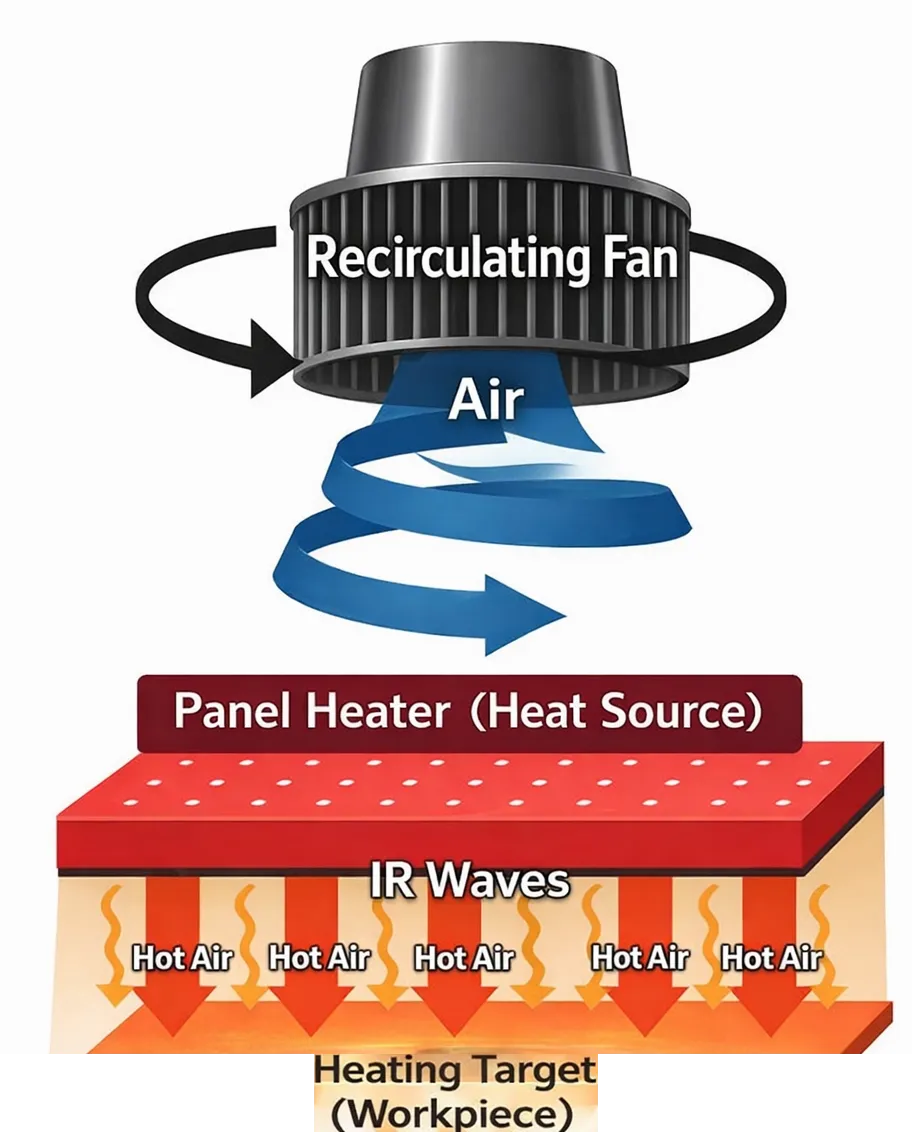
Antom’s heating method primarily uses convection heating with weak hot air, combined with radiant heating using far-infrared rays.
The hot air functions as the heating base, ensuring stable temperature control, while the far-infrared rays complement the heating capacity, which tends to decrease when the airflow is weakened.
The diagram below illustrates Antom’s unique hybrid heating method, which combines hot air and far-infrared rays.
Furthermore, because Antom’s equipment is compact, it is possible to ensure sufficient heating time by flexibly controlling the conveying speed.
This allows for the creation of a stable heating environment without relying on strong hot air.
This heating method provides the following benefits: (Click on the items below to see a description of the benefits)
When drying solvents such as moisture-proofing agents, applying strong hot air can cause warping and scattering. Similarly, thin workpieces such as micro-components and film/flexible circuit boards can be blown away or fluttered by strong hot air. To minimize the effects of strong hot air, our hybrid heating method, which combines reduced hot air volume with far-infrared radiation, is ideal.
The freedom to design zones is made possible by light winds.
Antom’s heating method employs weak hot air, which suppresses thermal interference between adjacent zones. As a result, it becomes possible to clearly separate temperatures for each zone, achieving the “large temperature difference settings that is difficult with heating methods using strong hot air.
On the other hand, with heating methods primarily using strong hot air, heat easily mixes between adjacent zones, making it difficult to set large temperature differences. Therefore, to finely control the temperature profile, it is necessary to increase the number of zones and set temperatures in small increments.
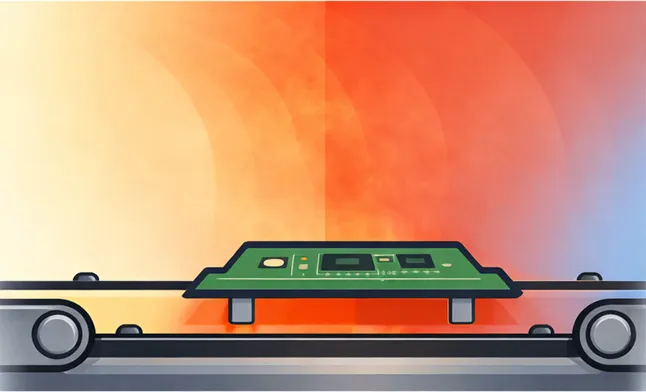
Below are convection images inside reflow ovens using strong and weak hot air. In a reflow oven with strong hot air, temperature interference between zones is large, and there is a strong tendency for lower temperatures to be drawn to higher temperatures. However, in a reflow oven with weak hot air, temperature interference between zones is small, making it possible to control the temperature for each zone.

This difference leads to significant differences in equipment design.
With Antom, temperature differences between zones can be maintained, allowing for a compact equipment design without unnecessarily increasing the number of zones. Conversely, in mass production lines, high-speed transport is required, necessitating rapid heating and the use of strong hot air. As a result, increasing the number of zones and lengthening the furnace is a rational choice.
In short, the difference in heating methods is not a matter of superiority or inferiority, but rather a matter of choosing the optimal method for the process and application.
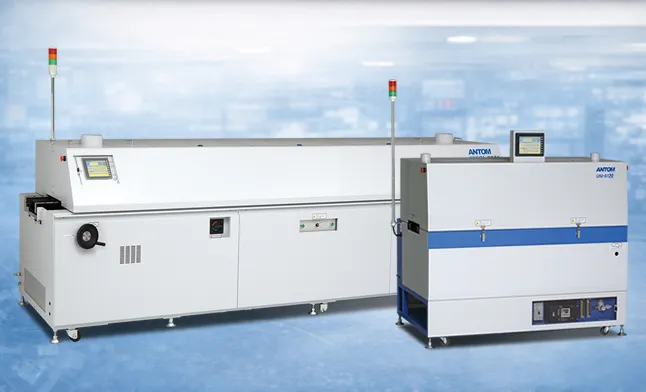
You can see the hybrid heating method, which combines low-temperature hot air and far-infrared rays, in action with the actual device.
As mentioned earlier, all of Antom’s reflow ovens, drying ovens, and curing ovens employ a hybrid heating system that combines hot air and far-infrared radiation. Therefore, you can see this hybrid heating system using the demo unit permanently installed in our demo room.
If you have any problems with your current heating system, please feel free to contact us.
If you have any problems or concerns regarding heating processes such as reflow, drying, or curing, please feel free to contact us. We welcome inquiries about products equipped with our unique heating methods, and we can also conduct evaluations and verifications using actual equipment in our demo room.
First, please select your inquiry item from the banner below and contact us using the inquiry form on each page.