

From Batch Ovens to Compact Reflow Ovens
Rethinking heating repeatability and productivity with compact reflow ovens
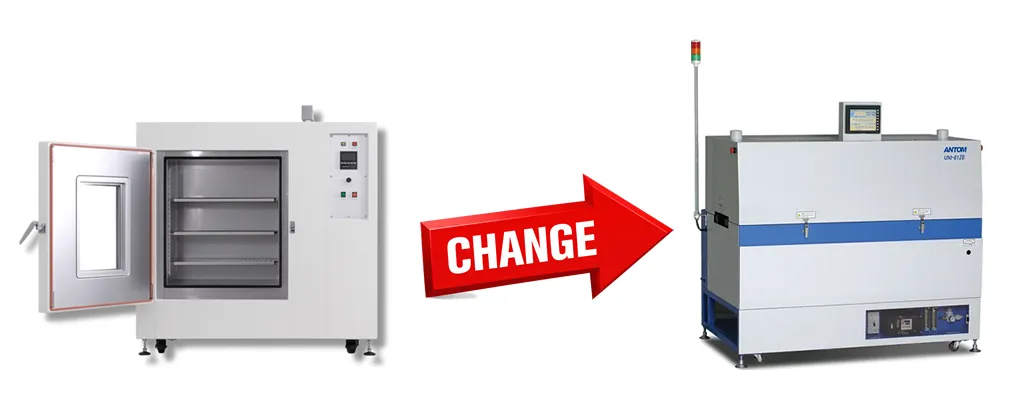
Heating processes using batch ovens are often continued simply because
“they work for now” or “this is how it has always been done.”
However, as manufacturers face increasing demands for production stability, quality repeatability, and solutions to labor shortages, the hidden limitations of batch oven heating are beginning to hold production back.
This page explains, from a real manufacturing perspective, what changes and what challenges can be resolved by transitioning from batch oven heating to compact conveyor-type reflow ovens.
Common challenges associated with batch oven heating
While batch ovens have a simple structure, maintaining consistent heating quality often requires significant manual adjustments and operator involvement.
Common issues include:
– Temperature variations caused by workpiece placement or stacking conditions
– Differences in heating depending on the position inside the oven
– Variations in loading and unloading timing between operators
– Actual temperature profiles that differ from lot to lot
As a result, it becomes common for processes to reach a state where
“the same conditions do not produce the same results.”
The often-overlooked issue of repeatability
In batch oven heating, the most critical issue is often not defects themselves, but a lack of repeatability.
This lack of repeatability leads to issues such as:
– Good process conditions remaining only as personal experience
– Difficulty identifying root causes when problems occur
– Increased challenges in quality assurance and customer explanations
These challenges affect not only mass production, but also prototyping, reliability testing, and evaluation processes.
The often-overlooked issue of repeatability
In batch oven heating, the most serious issue is often not the defects themselves, but the lack of repeatability.
This lack of repeatability leads to the following challenges:
– Good process conditions remain only as personal experience
– Root causes are difficult to isolate when issues occur
– Quality assurance and customer explanations become more difficult
These issues affect not only mass production, but also prototyping, reliability testing, and evaluation processes.
Choosing compact conveyor-type reflow ovens
A compact reflow oven is a system that controls heating on a zone-by-zone basis while conveying workpieces at a constant speed.
The decisive difference from batch ovens is that heating is managed not by time, but by temperature profiles.
This approach provides several important advantages:
– Every workpiece passes through the same temperature history
– Automated conveying eliminates reliance on operator judgment
– Process conditions can be reproduced and shared as numerical data
As a result, the heating process itself is transformed into a controllable and manageable process.
Changes achieved after transitioning to compact reflow ovens
Production sites that have transitioned from batch ovens to compact reflow ovens report the following improvements:
– Reduced variation in heating quality
– Shorter setup and process optimization time
– Elimination of operator-dependent variability
– A first step toward labor reduction and automation
One of the key advantages is that the process becomes more organized simply by changing the equipment—without requiring special process improvement initiatives.
Processes best suited for compact reflow ovens
Compact reflow ovens are easy to introduce even in space-limited environments and are well suited for applications where the goal is to automate a single process step as a starting point.
In particular, compact reflow ovens are well suited for the following processes:
– Operations using multiple batch ovens for different temperature conditions
– Prototyping, evaluation, and reliability testing
– High-mix, low-volume production or pilot production
– Processes where minimizing manual intervention is a priority
Why ANTOM’s compact reflow ovens are chosen
ANTOM’s compact reflow ovens employ a proprietary heating method that combines gentle airflow with far-infrared heating.
This approach enables heating that:
– Does not unintentionally move the workpiece
– Avoids rapid surface-only heating
– Delivers heat gently and evenly to the interior
As a result, issues commonly encountered with batch ovens can be resolved without simply replacing one problem with another.
The concept of “transitioning” to compact reflow ovens
There is no need to completely reject batch oven heating.
However, when considering factors such as:
– Repeatability
– Process controllability
– Future automation
it is also true that conveyor-type compact reflow ovens are becoming the next standard.
Transitioning from batch ovens to compact reflow ovens is not simply an equipment upgrade—it is a change in how the process itself is approached.
If heating-related challenges persist, we encourage you to reconsider what “optimal heating” truly means, starting from the equipment.
For those considering a transition from batch ovens
Evaluation using actual boards and component configurations, as well as process condition verification, is available.
For inquiries regarding ANTOM’s reflow ovens for SMT applications, please contact us using the form below.
We welcome consultations not only for equipment selection, but also for demonstrations using actual machines and temperature profile measurements.